
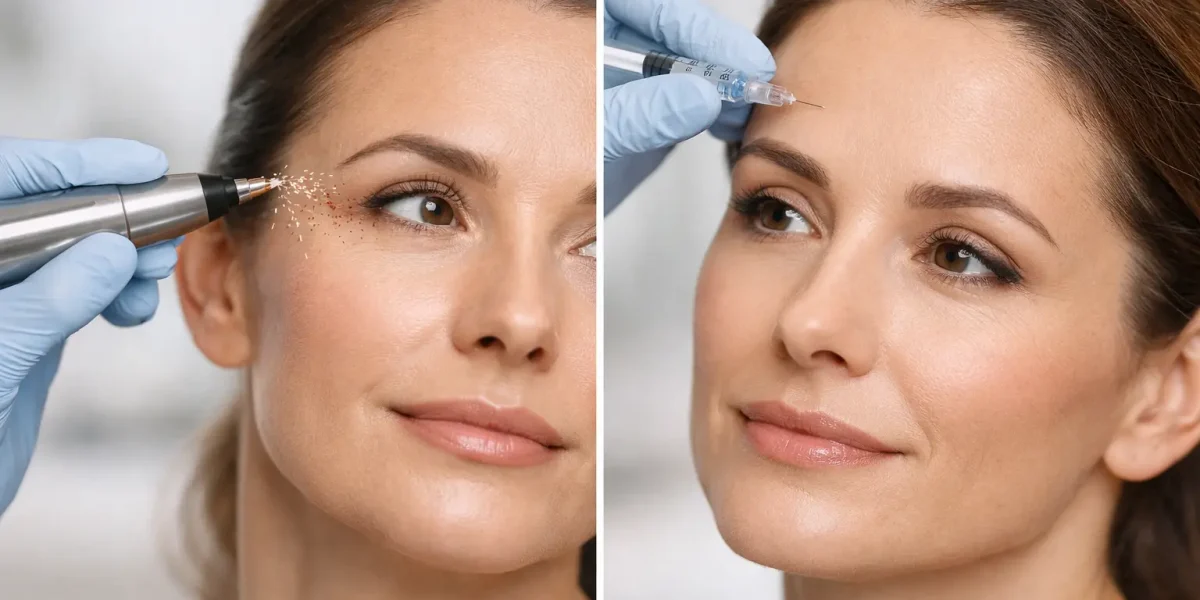
If you are staring at lines around the eyes, forehead creasing, or skin that suddenly looks less firm than it did six months ago, the real question is not what is trendy. It is what will actually give you the result you want. When clients ask about plasma lift versus botox, they are usually trying to solve one of two problems – wrinkles caused by movement, or skin laxity caused by aging. Those are not the same issue, and they should not be treated like they are.
That is where a lot of confusion starts. Botox and plasma lift are both popular non-surgical options, but they work in completely different ways. One relaxes muscle activity. The other tightens skin and stimulates collagen. If your goal is a smoother forehead, a softer crow’s foot area, a lifted eyelid, or firmer skin without injectables, the right answer depends on your anatomy, your goals, and how long you want your results to last.
Plasma lift versus botox: the real difference
Botox is a neuromodulator. It is injected into specific muscles to reduce movement that causes expression lines. That makes it especially useful for forehead lines, frown lines between the brows, and crow’s feet. If your wrinkles deepen when you smile, squint, or raise your brows, Botox can be very effective.
Plasma lift is different. It is a skin tightening treatment that uses plasma energy to create controlled micro-injuries on the skin’s surface. That process triggers contraction in the tissue and encourages collagen remodeling over time. In plain terms, it focuses on the skin itself rather than the muscle underneath it.
This distinction matters. If your main concern is loose upper eyelid skin, crepey under-eye texture, fine lines around the mouth, or skin that looks slack, Botox may not give you enough improvement because it does not remove laxity. Plasma lift can often address concerns that injections alone cannot.
What Botox does well
Botox earned its reputation for a reason. It is fast, familiar, and highly effective for dynamic wrinkles. Many clients love it because treatments are quick and downtime is minimal. Results typically start showing within a few days and settle in fully within about two weeks.
For women who want to soften expression lines without changing the overall character of the face, Botox can be a smart option. It can create a smoother, more rested appearance when it is done well and customized properly.
It also works best in areas where repetitive movement is the main problem. Think forehead lines from raising the brows, the vertical 11 lines from frowning, and crow’s feet from smiling. If those lines are your priority, Botox can be the direct answer.
The trade-off is longevity. Botox is temporary. Most people need maintenance every three to four months, sometimes a little longer depending on metabolism, dosage, and treatment area. That means the commitment is ongoing if you want to keep the result.
What plasma lift does well
Plasma lift is often the better conversation for clients who want visible tightening without surgery or injectables. It is especially appealing for women who are noticing that the skin itself looks thinner, looser, or more folded.
Common treatment areas include the upper eyelids, under-eye area, around the mouth, neck, and other zones where skin laxity is difficult to ignore. This is why plasma lift gets attention from people who are not just chasing wrinkle reduction. They want lifting, tightening, and a more defined look.
One of the strongest advantages is that results can continue improving over time. You may see an immediate tightening effect, but collagen production keeps working in the background for weeks and even months. That progressive improvement is a major reason many clients view plasma lift as an investment in longer-term rejuvenation rather than a short-term fix.
For the right candidate, it can also be a powerful option for asymmetry correction and delicate facial areas where precision matters. Isa Skincare’s approach with Avatar Skin Lift Therapy speaks directly to this need – results-driven skin tightening designed for clients who want visible change without the injection route.
Plasma lift versus botox for common concerns
Forehead lines
If the forehead lines are mostly caused by movement, Botox usually has the advantage. It relaxes the muscle responsible for folding the skin over and over. Plasma lift may improve skin quality in the area, but it does not stop the underlying repetitive motion in the same way.
Crow’s feet
For lines that appear strongly when smiling, Botox is often the simpler choice. But if the eye area also looks crepey or lax at rest, plasma lift may offer something Botox cannot – actual tightening of the skin.
Hooded eyelids
This is where plasma lift often stands out. Botox can create a slight brow lift in some cases, but it does not remove excess skin. If the issue is drooping upper lid skin rather than muscle-driven lines, plasma lift is usually more aligned with the goal.
Under-eye wrinkles
This area requires experience and careful assessment. Botox may help in select cases, but too much can create an unnatural look or affect expression. Plasma lift is often chosen when the concern is fine wrinkling, looseness, or crepey texture under the eyes.
Lip lines and lower face creasing
Botox has limited use here unless muscle activity is clearly the cause. Plasma lift is often more attractive for this area because it targets skin texture and tightening directly.
Downtime, comfort, and healing
If you want the least disruption possible, Botox wins on convenience. Appointments are short, and most clients return to normal activity almost immediately. You may have mild redness, tiny bumps at injection sites, or occasional bruising, but downtime is generally low.
Plasma lift asks for more patience. Because it works by creating controlled surface trauma, there is a healing period. Small carbon crusts form in the treated area and need time to shed naturally. Swelling can also happen, especially around the eyes. For some clients, that is a fair trade for longer-lasting tightening. For others, downtime is a deciding factor.
Comfort is also different. Botox involves injections. Plasma lift does not, but topical numbing is usually used because the treatment still creates sensation on the skin. Neither option should be approached casually, and both require skilled hands.
Which lasts longer?
This is where many clients lean toward plasma lift. Botox fades as muscle activity gradually returns, so maintenance is part of the plan. Plasma lift results can last much longer because the treatment is remodeling tissue rather than temporarily relaxing a muscle.
That does not mean plasma lift is one-and-done forever. Aging continues, collagen changes, and lifestyle affects skin quality. But if your priority is a result that develops and holds beyond a few months, plasma lift often has the stronger long-term appeal.
Who is a better candidate for each?
Botox is often ideal for someone who wants fast improvement in dynamic wrinkles, prefers minimal downtime, and is comfortable with maintenance appointments. It is also a familiar entry point for clients new to aesthetic treatments.
Plasma lift is often a better fit for someone who wants firmer skin, has mild to moderate laxity, wants to avoid injectables, or is trying to improve areas like the eyelids or under-eyes where tightening matters more than muscle relaxation.
Skin tone, skin condition, medical history, and healing habits all matter. Not every client is a candidate for every treatment. A real consultation should never be a one-size-fits-all recommendation.
Can plasma lift and Botox work together?
Yes, in the right treatment plan. This is not always an either-or decision.
If you have dynamic lines plus skin laxity, combining approaches may make the most sense. Botox can reduce the muscle movement that keeps etching lines into the skin, while plasma lift can tighten and improve the texture of the skin itself. The result can be more balanced and more complete than using either treatment alone.
The key is timing and professional judgment. Treatments should be mapped to your face, your skin behavior, and your priorities instead of copied from someone else’s before-and-after photo.
The best choice is the one that matches the problem
The strongest beauty decisions come from clarity, not hype. If your wrinkles are caused by facial movement, Botox may be the right tool. If your concern is loose, crepey, aging skin that needs tightening and collagen support, plasma lift may give you a result that feels more meaningful.
Aging does not show up in one way, and rejuvenation should not be approached with one answer. The smartest path is to choose the treatment that matches what your skin is actually asking for – not just what happens to be most talked about at the moment.