
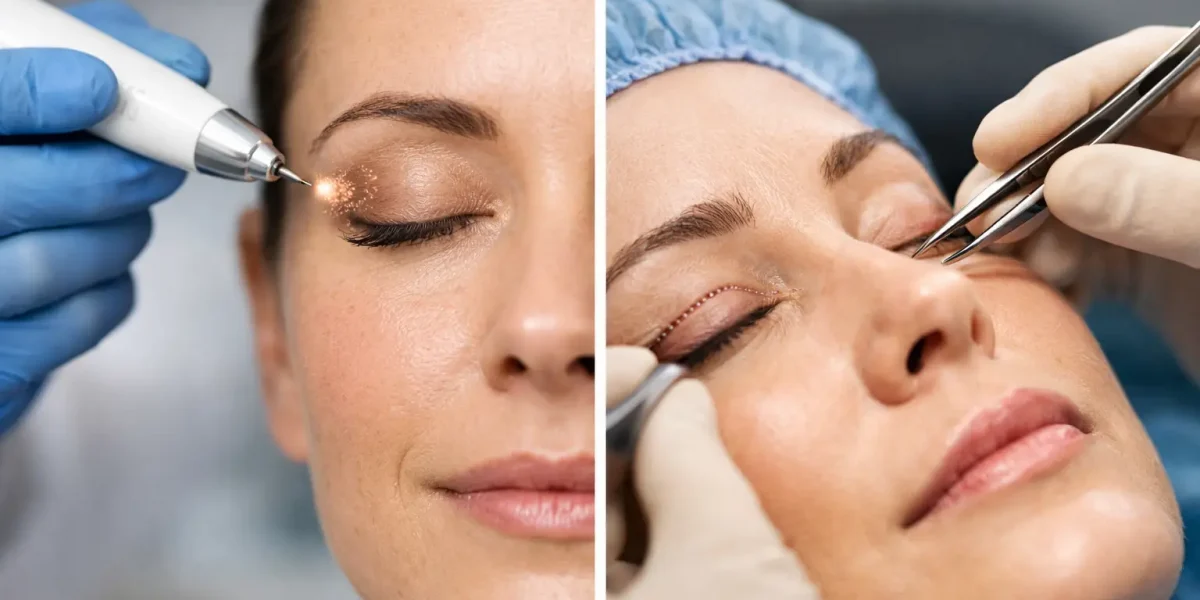
Loose upper eyelid skin can make you look tired even when you feel fully awake. When clients ask about fibroblast vs blepharoplasty, they are usually asking one real question: how do I get a lifted, fresher eye area without choosing the wrong level of treatment?
That answer depends on how much skin laxity you have, how quickly you want to recover, and whether you want a non-surgical approach or a surgical correction. Both options can improve hooded lids and crepey skin, but they do it in very different ways. If you understand the trade-offs clearly, the right choice gets much easier.
Fibroblast vs blepharoplasty: the core difference
Fibroblast treatment is a non-surgical skin-tightening procedure that uses plasma energy to create tiny controlled dots on the skin surface. This stimulates contraction and collagen production, which can tighten lax skin over time. It is often chosen by women who want visible improvement without incisions, stitches, or the commitment of surgery.
Blepharoplasty is eyelid surgery. A surgeon removes or repositions excess skin, and sometimes fat, to create a cleaner upper lid or reduce puffiness below the eyes. It is more invasive, but it can also deliver a more dramatic correction when the issue is structural rather than mild to moderate skin laxity.
So the shortest version is this: fibroblast tightens and lifts skin without surgery, while blepharoplasty surgically removes excess tissue.
Who is fibroblast best for?
Fibroblast is often the better fit for someone with mild to moderate hooding, crepey texture, fine lines, or early skin laxity around the eyes. It appeals to clients who want a fresher look but are not ready for surgery, general anesthesia, or a longer healing process.
It is also attractive for women who want a softer, more gradual improvement. The skin contracts early, but collagen remodeling continues for weeks and months. That means results can keep improving after the treatment itself.
This option is not about changing your face. It is about tightening what is already there, refining the eye area, and making you look more rested. For many women, that is exactly the sweet spot.
Who is blepharoplasty best for?
Blepharoplasty is usually better for advanced eyelid hooding, significant excess skin, or lower eyelid bags caused by fat protrusion. If the upper lid skin is hanging enough to affect makeup application or even vision, surgery may be the more effective route.
This is also the right conversation when someone wants a one-time structural correction rather than a skin-tightening treatment. A surgeon can physically remove the excess tissue. Fibroblast cannot do that. It can contract and improve laxity, but it does not replace surgery in severe cases.
That distinction matters. Non-surgical does not mean weak, but it does mean there are limits.
Results: subtle refinement or surgical correction?
This is where expectations have to be honest.
Fibroblast can create a noticeable lift in the right candidate. It can smooth crepiness, reduce the appearance of hooding, and improve overall skin firmness around the eye. For clients with mild to moderate laxity, the before-and-after difference can be impressive while still looking natural.
Blepharoplasty usually produces a bigger change. Because skin and fat can be removed or repositioned, the outcome can be more dramatic and more immediate once healing settles. If you have a lot of excess skin, surgery often gives the stronger result.
The question is not which one is universally better. The question is whether you need refinement or correction. If your concern is early laxity, fibroblast may be enough. If your concern is heavy, redundant tissue, blepharoplasty may be more appropriate.
Downtime and healing
For many clients, downtime is the deciding factor.
After fibroblast, the treated area develops small carbon crusts or dots that stay visible for several days. Swelling around the eyes is common, especially in the first 24 to 72 hours. Most people plan for about a week of social downtime, sometimes a little longer depending on how their skin responds.
Blepharoplasty usually comes with bruising, swelling, tenderness, and a longer recovery window. Stitches may need to be removed, and while many people feel presentable within 10 to 14 days, final settling takes longer. Recovery is still manageable, but it is more involved.
If your schedule cannot accommodate surgery, fibroblast may feel far more realistic. If you are willing to trade more downtime for a stronger correction, blepharoplasty may be worth it.
Scarring, risk, and comfort level
One of the biggest reasons clients compare fibroblast vs blepharoplasty is fear of scarring.
Fibroblast is known for delivering skin tightening without surgical incisions. That is a major advantage for clients who want visible improvement but do not want the psychological or physical barrier of surgery. When performed correctly, the treatment points heal as part of the skin renewal process.
Blepharoplasty does involve incisions, although a skilled surgeon places them carefully in the natural eyelid crease or close to the lash line, depending on the area treated. Scars are usually discreet once healed, but they are still part of surgery.
Risk profile matters too. Fibroblast carries risks such as swelling, temporary redness, hyperpigmentation in some skin types, infection if aftercare is ignored, and results that vary based on skin quality and provider technique. Blepharoplasty carries surgical risks including bleeding, asymmetry, dry eye, visible scarring, prolonged swelling, and anesthesia-related concerns.
Neither treatment should be chosen casually. The provider matters as much as the procedure.
Cost: upfront price vs overall value
Fibroblast is generally less expensive upfront than blepharoplasty. That makes it appealing to clients who want meaningful rejuvenation without the cost of surgery, operating fees, and anesthesia.
But price alone can be misleading. If you need surgery because your laxity is advanced, paying less for a treatment that cannot fully address the issue is not really saving money. On the other hand, if you are a strong fibroblast candidate, surgery may be more than you need.
Value comes from fit. The best investment is the treatment that matches your anatomy, your goals, and your tolerance for downtime.
Fibroblast vs blepharoplasty for hooded eyes
Hooded eyes are one of the most common reasons people seek treatment, but not all hooding is the same.
If the hooding comes from mild skin laxity, fibroblast can be an excellent option. It can tighten the upper lid area and create a more open appearance without changing your natural expression. This is why plasma-based soft surgery has become so appealing to women who want lift without going fully surgical.
If the hooding is severe, or if there is a significant amount of hanging skin, blepharoplasty may be the better choice. In those cases, skin needs to be removed, not simply tightened.
A skilled consultation should tell you which category you are in. No treatment should be sold as a miracle when you actually need a different level of correction.
Why some clients choose soft surgery first
There is a growing group of women who want results, but they want to start with the least invasive effective option. That is where advanced plasma tightening stands out.
A well-executed fibroblast treatment offers a middle ground between creams that do very little and surgery that may feel like too much. It can deliver lifting, smoothing, and collagen stimulation with fast healing compared to surgical recovery. For the right person, that is a powerful place to start.
At Isa Skincare, that philosophy is part of why soft-surgery solutions are so appealing. Women want real change, but they also want to protect their time, their comfort, and their natural beauty.
How to choose without second-guessing yourself
Start with your actual concern, not the trendiest treatment. Are you dealing with early laxity and texture, or with heavy excess skin? Do you want gradual tightening or a stronger surgical correction? Are you comfortable with incisions, or do you strongly prefer a non-surgical path?
Then look at the provider. Fibroblast results depend heavily on technique, treatment design, and aftercare guidance. Blepharoplasty results depend heavily on surgical judgment and precision. In either case, expertise changes everything.
The smartest decision is not the most aggressive one. It is the one that fits your face, your goals, and your lifestyle with the fewest compromises.
If you are comparing fibroblast vs blepharoplasty, you are already asking the right question. The next step is choosing the option that gives you confidence when you look in the mirror, not just on day one, but months later when the healing is done and the result is truly yours.